
Daylighting vs. Glare: Finding the Balance
Natural light can transform your home, making it brighter and more inviting while cutting energy costs. But for many North Texas homeowners, especially those with 20–35-year-old builder-grade aluminum windows, too much sunlight can lead to frustrating glare, higher cooling bills, and even discomfort. Balancing daylight with proper glare control is essential for comfort, productivity, and energy efficiency – especially in Texas, where intense sun and heat are constant challenges.
Key Takeaways:
- Daylight Benefits: Improves mood, supports sleep, and reduces artificial lighting needs by up to 80% in well-designed spaces.
- Glare Challenges: Causes visual discomfort, productivity loss, and increased reliance on artificial lighting.
- Modern Solutions: FGIA-certified Low-E glass, dynamic shading, and strategic window placement can reduce glare, block heat, and maximize comfort.
- Local Context: Homes in Plano, Frisco, and McKinney often face issues like faded interiors, high UV exposure, and inefficient builder-grade windows.
Whether you’re dealing with west-facing windows that overheat your living room or outdated glass that can’t block UV rays, modern window technology can solve these problems while keeping your home bright and energy-efficient. Let’s explore how to achieve the perfect balance.
Daylighting for Health and Energy Savings
The Benefits of Daylighting
Designing your home to maximize natural light can improve your health, increase comfort, and even help lower your energy bills.
Health and Well-Being
Natural light plays a crucial role in keeping your body’s internal clock, or circadian rhythm, on track. This rhythm helps regulate when you feel awake during the day and when you’re ready to sleep at night. A study conducted in September 2021 by the Mount Sinai Light and Health Research Center observed 20 residents in a Reston, Virginia apartment complex. The findings revealed that those with better access to daylight fell asleep 22 minutes earlier and maintained more consistent sleep patterns compared to those who kept their blinds closed [8].
“Daylight is an ideal light source for promoting circadian alignment due to its natural 24 h cycle, high light levels, and spectral power distribution which provides the proper circadian stimulus at all times of day.” – Rohan Nagare, Light and Health Research Center, Mount Sinai [8]
The benefits don’t stop at sleep. Natural light also supports mental health. A separate study from September 2021, conducted in Durham, North Carolina, examined 30 office workers. Those working in spaces with ample daylight were 77% less likely to report feeling depressed and 48% less likely to experience eyestrain [6]. Additionally, sunlight helps your body produce vitamin D, which supports immune health, strengthens bones, and aids calcium absorption [7]. With an estimated 1 billion people worldwide experiencing vitamin D deficiency, allowing sunlight into your home isn’t just about comfort – it’s an important step toward better health [7].
On top of these health benefits, daylighting can also make a noticeable difference in your energy consumption.
Energy Efficiency
Daylighting isn’t just good for your well-being; it’s also great for your wallet. Electric lighting accounts for roughly 8–15% of residential energy use, but daylight-linked controls can cut lighting energy consumption by 30% to 60% [9].
Natural light can also help with cooling costs. Light fixtures generate heat, and turning them off during the day reduces the amount of heat in your home. This is especially important in North Texas, where summer temperatures often soar above 95°F, and air conditioners work overtime from May through September [2] [9]. The key to maximizing these savings lies in using windows with advanced glazing technology. These windows let in plenty of natural light while blocking excess heat, making them an excellent choice for balancing comfort and efficiency. Modern window designs have made achieving this balance easier than ever.
The Challenges of Glare
Natural light can brighten up your home and mood, but when sunlight isn’t controlled, it can create significant problems. From visual discomfort to higher energy bills, glare can disrupt daily life in more ways than you might expect.
Visual Discomfort and Productivity Loss
Glare can make even the simplest tasks frustrating. It comes in two forms: disability glare and discomfort glare. Disability glare happens when light reflects off surfaces like a computer screen or a book, creating a “veil” effect that obscures details. Imagine trying to read a book, but the contrast between the black ink and white page is so washed out that the words almost disappear. On the other hand, discomfort glare occurs when a bright light source – like sunlight streaming in from the side – competes with the light you’re focusing on, making it hard to concentrate.
“Discomfort glare arises when light from the side of the task is much brighter than the light coming from the task… Prolonged exposure to such conditions can result in headaches and eye fatigue.” – Florida Solar Energy Center [10]
Uncontrolled glare doesn’t just make it harder to see; it can lead to headaches, eye strain, and even reduced productivity. For those working from home, glare on computer screens can contribute to Computer Vision Syndrome, a condition linked to prolonged screen use under poor lighting conditions [12]. Low-angle sunlight, especially through east- and west-facing windows, can make these issues worse [1][2].
There’s also the issue of contrast. Ideally, the brightest spot in a room shouldn’t be more than 10 times brighter than the darkest spot. When this balance is off, indirect glare can become a problem [2]. These visual challenges not only affect comfort but also have a ripple effect on energy use, as we’ll explore next.
Thermal and Energy Impacts
Glare isn’t just about visual discomfort – it also impacts your home’s energy efficiency. When sunlight becomes overwhelming, people often close blinds or shades to block it out. While this might solve the glare issue temporarily, it also shuts out natural light, leading to increased reliance on artificial lighting [11][12]. Interestingly, research shows that people tend to adjust their blinds only 6% of the day, often leaving them closed for long periods [12].
The problem doesn’t stop there. Along with glare, sunlight brings heat. Infrared radiation from the sun increases solar heat gain, making your air conditioning system work overtime to maintain a comfortable temperature [10][2]. In hot climates, managing glare and solar heat effectively – such as with exterior shading – can cut energy use significantly, reducing cooling demands. Additionally, without proper glare control, homes miss out on reducing artificial lighting energy use by up to 80% [2].
Modern Window Technologies That Balance Daylighting and Glare
Window innovations have come a long way from the basic builder-grade aluminum frames of the past. Today’s windows feature advanced coatings, multi-pane designs, and even dynamic glass systems, all aimed at maximizing natural light while keeping glare and heat under control. These advancements make it easier to enjoy the benefits of sunlight without the downsides, especially in homes dealing with Texas heat and intense UV exposure.
Low-E Glass and Multi-Pane Systems
Low-emissivity (Low-E) glass is a game-changer for homeowners looking to improve energy efficiency. These coatings, made from ultra-thin layers of metal or metallic oxide, are practically invisible yet highly effective at managing heat and light[13]. What’s particularly impressive is how these coatings can be customized during manufacturing to allow just the right amount of visible light to pass through while blocking infrared radiation – the heat-producing part of sunlight[13].
For hot climates like Texas, spectrally selective Low-E coatings can block a substantial portion of solar heat . These coatings can block 40% to 70% of solar heat while still letting in ample visible light[13]. This means you can enjoy bright, sunlit interiors without turning your home into a sauna.
“In those climate where cooling loads dominate, you will want a glazing that provides daylight and view but transmits as little of the sun’s non-visible infrared radiation as possible.” – U.S. Department of Energy[13]
When combined with multi-pane insulating glass units (IGUs) filled with inert gases like argon or krypton, Low-E coatings reduce energy loss by approximately 30%–50% compared to single-pane glass. Today, Low-E coatings are used in over 80% of residential windows sold in the U.S.
Another advantage of high-performance windows is their ability to manage glare. By increasing the overall brightness of interior walls and ceilings, they create a more balanced and comfortable lighting environment[10]. If you’re shopping for new windows, pay attention to the Visible Transmittance (VT) rating on the National Fenestration Rating Council (NFRC) label. A higher VT allows more natural light to pass through, while a lower VT can help reduce glare in areas with intense sunlight exposure[13].
| Feature | Low-E Glass | Clear Glass |
|---|---|---|
| Energy Loss | Reduced by 30%–50%[13] | Standard baseline |
| Heat Filtration | Blocks 40%–70% of infrared heat[13] | Minimal filtration |
| Daylight Control | Adjustable transmittance[13] | Fixed high transmittance |
| Cost | 10%–15% higher upfront[13] | Lower upfront cost |
For those seeking even more control, dynamic glass and light-diffusing solutions offer advanced options for managing daylight and glare.
Dynamic Glass and Light-Diffusing Solutions
Dynamic glass, often referred to as “smart glass”, takes window technology to the next level. This glass can automatically dim or tint in response to sunlight, occupancy, or manual controls – all without obstructing your view[16]. It can adjust visible light transmittance by up to 90%, helping to manage harsh glare while blocking 40% to 98% of harmful UVA and UVB rays[2][15]. Used in everything from airplanes to iconic buildings, dynamic glass is known for its ability to reduce energy costs and improve indoor comfort.
On the other hand, light-diffusing solutions focus on scattering sunlight into a soft, uniform glow. Textures or films applied to the glass eliminate harsh direct light, though they may obscure the view to some extent[17][18]. For example, Polymer-Dispersed Liquid-Crystal (PDLC) films can instantly switch from clear to opaque with the flip of a switch, offering privacy while still allowing diffused light to brighten the room[18]. Unlike electrochromic glass, which retains the outside view even when tinted, light-diffusing technologies prioritize glare reduction over visibility[16][17].
One notable application of this technology is at the University of Toronto, where Smart Film Technology was used on a curtain wall in the swimming pool viewing area. This setup provides on-demand privacy while maintaining natural light[16]. For homeowners not ready to replace their windows entirely, many of these films can be applied as retrofits, making them a practical and flexible option[16][18].
“Smart glass allows the homeowner to tint or untint window glass as needed at the touch of a button.” – Quality Glass Block Team[15]
Dynamic glass typically costs between $50 and $100 per square foot, making it about 50% more expensive than traditional windows[15]. However, the energy savings – estimated at around 20%[15] – can help offset the higher upfront cost over time. These advancements open up exciting possibilities for homeowners seeking to refine daylighting and glare control.
For those ready to move beyond builder-grade windows, Optimal Windows provides FGIA-certified installations that seamlessly incorporate these cutting-edge technologies, ensuring your home enjoys the perfect balance of natural light and comfort.
Design Strategies for Daylighting and Glare Control
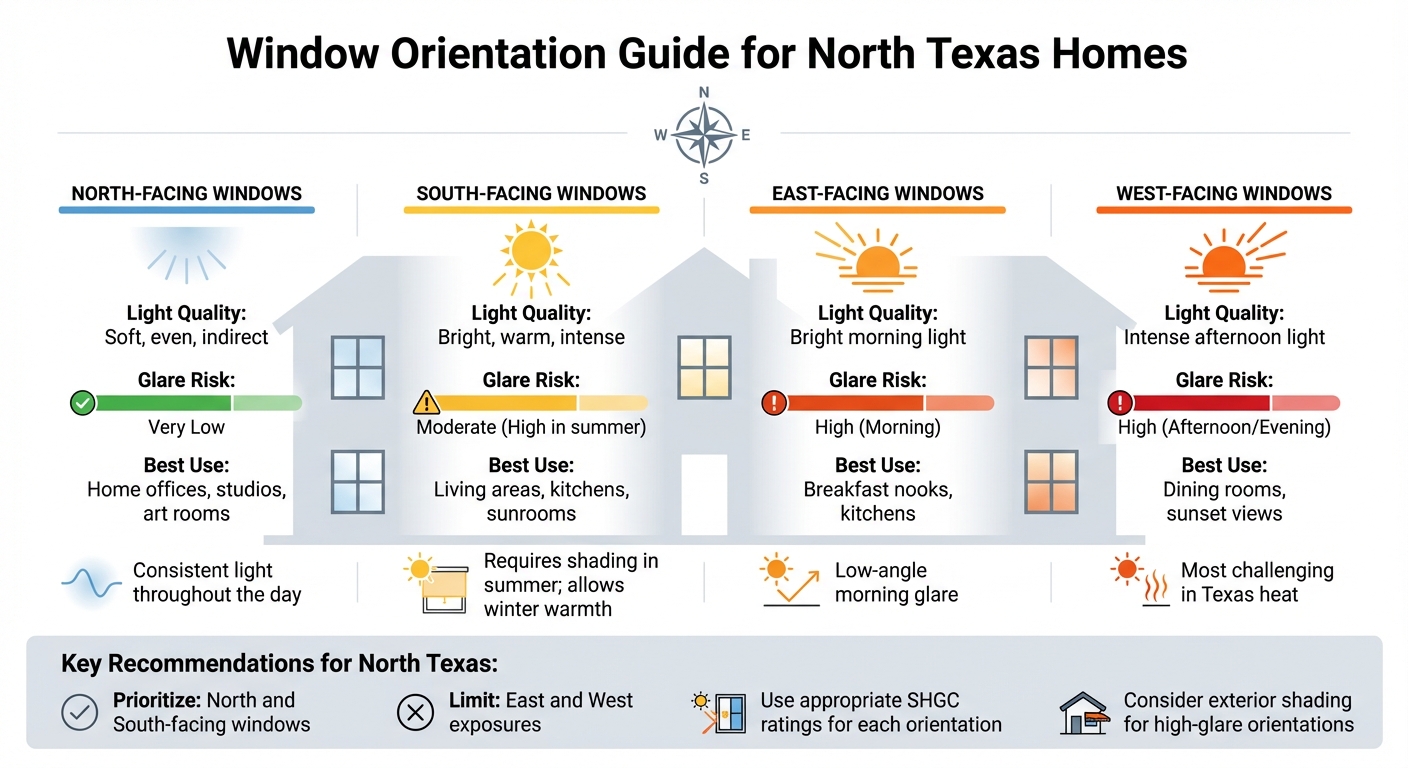
Window Orientation Guide: Light Quality, Glare Risk, and Best Room Uses
Creating a bright, comfortable home means more than just choosing the right windows – it’s about thoughtful design. In North Texas, where the afternoon sun can feel relentless and UV exposure is a constant challenge, strategic window placement and shading are essential to avoid issues like harsh glare and overheating.
Window Orientation and Placement
Where your windows face has a huge impact on the quality of light they bring in and the risk of glare. For instance, north-facing windows provide consistent, soft light throughout the day with minimal glare. These are perfect for spaces like home offices, art studios, or any room where even lighting is key[19][1]. On the other hand, south-facing windows allow plenty of natural light and warmth, especially during winter when the sun’s angle is lower. However, without proper shading, they can lead to overheating and glare during the summer months[19][1].
East- and west-facing windows are trickier. Morning sunlight from the east and afternoon sunlight from the west hit at low angles, which can lead to intense glare and heat buildup. West-facing windows are particularly challenging in Texas, where afternoon temperatures soar, making it critical to manage the sunlight that pours in.
To balance daylight while reducing glare, consider clerestory windows. These higher-placed windows let natural light penetrate deeper into your home without directly hitting eye level[20][3]. Larger windows can also help by spreading light more evenly across walls and ceilings, reducing the harsh contrast of glare. Just be sure to pair larger windows with proper glazing to control solar heat gain[10].
| Orientation | Light Quality | Glare Risk | Best Use |
|---|---|---|---|
| North | Soft, even, indirect | Very Low | Home offices, studios, art rooms |
| South | Bright, warm, intense | Moderate (High in summer) | Living areas, kitchens, sunrooms |
| East | Bright morning light | High (Morning) | Breakfast nooks, kitchens |
| West | Intense afternoon light | High (Afternoon/Evening) | Dining rooms, sunset views |
For homes in Plano, Frisco, and other parts of North Texas, it’s smart to prioritize north and south-facing windows while limiting east and west exposures. When replacing older builder-grade windows, think about the orientation of each opening and choose glass with the right Solar Heat Gain Coefficient (SHGC) to match the exposure.
Shading Systems for Dynamic Control
Shading systems are an excellent way to manage sunlight and glare, especially as the sun’s position changes throughout the day. For maximum effectiveness, exterior shading is the way to go since it blocks solar radiation before it even reaches the glass. For south-facing windows, roof overhangs are a practical choice – they can block the high-angle summer sun while still allowing the lower winter sun to warm your home naturally[24].
East and west-facing windows require a different approach since they deal with low-angle sunlight. Vertical shading options, such as solar screens, exterior shutters, or even landscaping with trees and shrubs, can be highly effective[24]. Another great option is window awnings, which can reduce solar heat gain by up to 65% on south-facing windows and 77% on west-facing ones[21].
For interior shading, solar shades are a popular choice. These shades filter sunlight while maintaining your view of the outdoors and come in various “openness” levels (1%, 3%, 5%, or 10%). For areas prone to glare, like home offices, a darker fabric with 1–3% openness works best. Dark-colored fabrics absorb light, making them less reflective and helping to maintain a clear view outside[22][25].
If you’re looking for convenience, automated shading systems are a fantastic solution. These systems can adjust based on the time of day or the sun’s position, ensuring your home stays comfortable without constant manual adjustments[22][23]. Pre-wiring for motorized shades during your window replacement project is a smart move that allows for seamless upgrades down the line[24].
“Sheer shades can filter bright sun so you can work, cook, or relax comfortably – no need to close off the outdoors.” – Lutron Luxury[23]
For a simple yet effective trick, adjust horizontal blinds so the slats tilt upward. This directs light toward the ceiling, which acts as a natural diffuser, spreading soft, even light throughout the room without the harshness of direct glare[21]. Pairing this with light-colored interior walls can further reflect and distribute light, creating a more balanced and inviting space[10][3].
In North Texas homes, where the sun can be both a blessing and a challenge, the right combination of shading systems and window placement can make all the difference. Whether you’re dealing with the intense afternoon sun on west-facing windows or trying to maximize the soft light in a north-facing room, Optimal Windows can guide you through the process. With FGIA-certified expertise, they’ll ensure your new windows and shading strategies are tailored to your home’s unique needs.
Addressing Daylighting and Glare in North Texas Homes
Texas Heat and UV Protection
Living in Plano, Frisco, McKinney, or North Dallas means you’re no stranger to the relentless Texas sun. During the scorching summer months, about 76% of sunlight hitting standard windows turns into heat inside your home, pushing your HVAC system to work overtime and driving up energy bills[28].
But it’s not just the heat. Those intense rays also bring harmful UVA and UVB radiation that can wreak havoc on your interiors. Over time, these rays cause your furniture, carpets, artwork, and wood floors to fade, leaving them looking worn and dull[29][30].
Thankfully, advanced glass technology can help. For the North Texas climate, ENERGY STAR recommends windows with a U-Factor of 0.30 or lower and a Solar Heat Gain Coefficient (SHGC) of 0.25 or less[27]. Spectrally selective Low-E glass, like Cardinal LoĒ‑340, is a game-changer. It blocks infrared heat while still allowing in natural daylight, so you can enjoy bright spaces without the added heat. Combine this with Argon or Krypton gas fills between the panes, and you’ve got an extra layer of thermal insulation to keep your home comfortable all year long[28]. When it comes to frame materials, vinyl and fiberglass outperform aluminum by a wide margin since they don’t conduct heat as easily[27].
By upgrading your windows, you can tackle these heat and UV challenges head-on while replacing outdated materials that fail to address modern energy efficiency and comfort needs.
Replacing Builder-Grade Windows
The Texas sun isn’t the only challenge – outdated builder-grade windows in homes built 20 to 35 years ago in Plano, Frisco, and McKinney add another layer of discomfort. These older windows weren’t designed to handle the demands of daylighting or glare control. Without the necessary spectral selectivity, they let in too much light and heat, often creating uncomfortable glare where the windows appear far brighter than the rest of the room[10]. Many homeowners resort to keeping their shades closed all the time, sacrificing the benefits of natural daylight just to avoid the discomfort[5].
Replacing these older windows with FGIA-certified options can completely change the game. FGIA Gold Label products meet strict standards for air infiltration, structural strength, and water resistance, ensuring your new windows perform as promised[26]. Modern windows with spectrally selective Low-E glazing strike a balance between letting in natural light and reducing glare, achieving what’s called “effective aperture.” This means you get the right amount of visible light without overwhelming your cooling system or relying too much on artificial lighting[5].
Optimal Windows specializes in replacing builder-grade aluminum windows throughout Plano, Frisco, McKinney, and North Dallas. With FGIA-certified installation and access to the full Cardinal glass lineup – including LoĒ‑366 for all-around efficiency, LoĒ‑340 for west and south-facing windows, and Quad LoĒ‑452+ for maximum heat resistance – they can customize your window replacement to suit your home’s unique sun exposure and comfort requirements. Choosing the right glass for each elevation can make a world of difference in creating bright, glare-free spaces you’ll love.
Conclusion: Achieving the Right Balance
Creating a home with abundant daylight and minimal glare involves blending modern window technologies with smart design choices. Advanced Low-E glass, for example, allows 40%–70% of solar heat to be blocked while still letting in full daylight[13]. However, these benefits are maximized when paired with thoughtful window placement. North-facing windows provide soft, even light, while east and west-facing windows demand careful consideration to manage glare and heat.
For south-facing windows, fixed overhangs are a practical solution. They block the high, intense summer sun while still allowing lower winter sunlight to brighten your space and reduce heating needs[10]. Indoors, light-colored walls and ceilings can reflect natural light deeper into your home, creating a more balanced and comfortable environment while reducing the sharp contrasts that strain your eyes[10][3]. These combined strategies not only improve comfort but also contribute to energy efficiency.
In North Texas, where the sun can be relentless, upgrading outdated windows to FGIA-certified installations is a smart move. By choosing the right Cardinal glass for each exposure – like LoĒ-340 for harsh west and south-facing windows, LoĒ-366 for overall efficiency, or Quad LoĒ-452+ for managing extreme heat – you can tackle the challenges of intense sunlight while enhancing your home’s performance.
Daylighting can reduce the need for artificial lighting by as much as 80%, while advanced Low-E coatings, despite adding 10%–15% to initial costs, can cut energy loss by 30%–50%[2][13]. This means you can enjoy brighter, more inviting spaces without feeling the need to keep your blinds closed all day.
Optimal Windows specializes in providing these tailored, FGIA-certified solutions, ensuring homes in Plano, Frisco, McKinney, and North Dallas achieve the perfect blend of natural light, comfort, and energy efficiency.
FAQs
How can I enjoy natural light in my home without dealing with glare?
Balancing natural light with glare control involves understanding how sunlight interacts with your home. Modern energy-efficient windows equipped with low-E coatings or tinted glazing are designed to let in plenty of sunlight while minimizing glare and reducing heat from the sun’s rays. To further manage direct sunlight, especially on south-facing windows, adding exterior shading like overhangs or louvers can make a noticeable difference.
Inside your home, solutions like adjustable blinds, low-reflectivity window films, or motorized shades can adapt to changing light throughout the day, giving you control over brightness and comfort. Strategically placing work areas near north-facing windows or using light-colored walls and ceilings can also amplify natural light by reflecting and diffusing it more evenly.
In Texas, where intense heat and UV exposure are part of daily life, selecting FGIA-certified, energy-efficient windows is a smart way to ensure proper glare control, durability, and year-round comfort. With professional installation, such as the services provided by Optimal Windows, you can enjoy a bright, welcoming home without the nuisance of excessive glare.
What are the best windows for keeping homes cool in Texas heat?
In the sweltering Texas heat, the right windows can make a world of difference, keeping your home cool and your energy bills manageable. Modern windows are designed to block excessive solar heat while still allowing natural light to brighten your space. One of the key technologies behind this is low-emissivity (low-E) coatings. These coatings work by reflecting infrared radiation, which helps reduce heat gain without sacrificing the brightness in your home. Pair this with double- or thin-triple-pane glass filled with inert gases like argon or krypton, and warm-edge spacers, and you’ve got a window system that keeps indoor temperatures steady and energy costs lower.
The material of the window frame is just as important as the glass. Vinyl, fiberglass, and wood-composite frames are excellent choices because they resist heat transfer far better than traditional metal frames, which can act like a heat conductor. Additionally, selecting windows with a low Solar Heat Gain Coefficient (SHGC) ensures less heat enters your home, reducing the strain on your air conditioning system during those blazing summer months. For even more protection, consider exterior shading options like overhangs or motorized blinds. And for cutting-edge performance, smart glazing that tints automatically can adapt to changing sunlight, offering both comfort and efficiency.
At Optimal Windows, we specialize in FGIA-certified, energy-efficient windows designed specifically for the challenges of Texas homes. Whether you live in Plano, Frisco, or North Dallas, our installations combine advanced low-E glass, durable frame materials, and shading solutions to help your home stay cool, comfortable, and free from harsh glare – even during the peak of summer.
What’s the best way to position windows for natural light and energy efficiency?
Positioning your windows thoughtfully can make a big difference in bringing natural light into your home while keeping energy use in check. In North Texas, south-facing windows are particularly useful during the winter months. The lower angle of the sun allows sunlight to reach deeper into your home, helping to naturally warm your spaces. To keep things cool during the summer, adding overhangs or exterior shading can block the higher-angle sun and prevent overheating. Meanwhile, north-facing windows provide a steady, soft light throughout the day without the intense glare or heat, making them ideal for home offices or other areas where consistent lighting is key.
To create the best balance, prioritize south- and north-facing windows for most of your natural lighting needs. By keeping east- and west-facing windows to a minimum, you can avoid the harsh glare and extra cooling demands that often come with them. Pairing this thoughtful placement with energy-efficient features, like low-E glass coatings and shading options such as awnings or louvers, can further enhance your home’s comfort and efficiency. With the right combination of smart design choices and high-performance windows, you can enjoy well-lit, comfortable interiors while keeping energy costs in check. For professional advice and FGIA-certified installations in Plano, Frisco, McKinney, Allen, and North Dallas, you can count on Optimal Windows to guide you every step of the way.